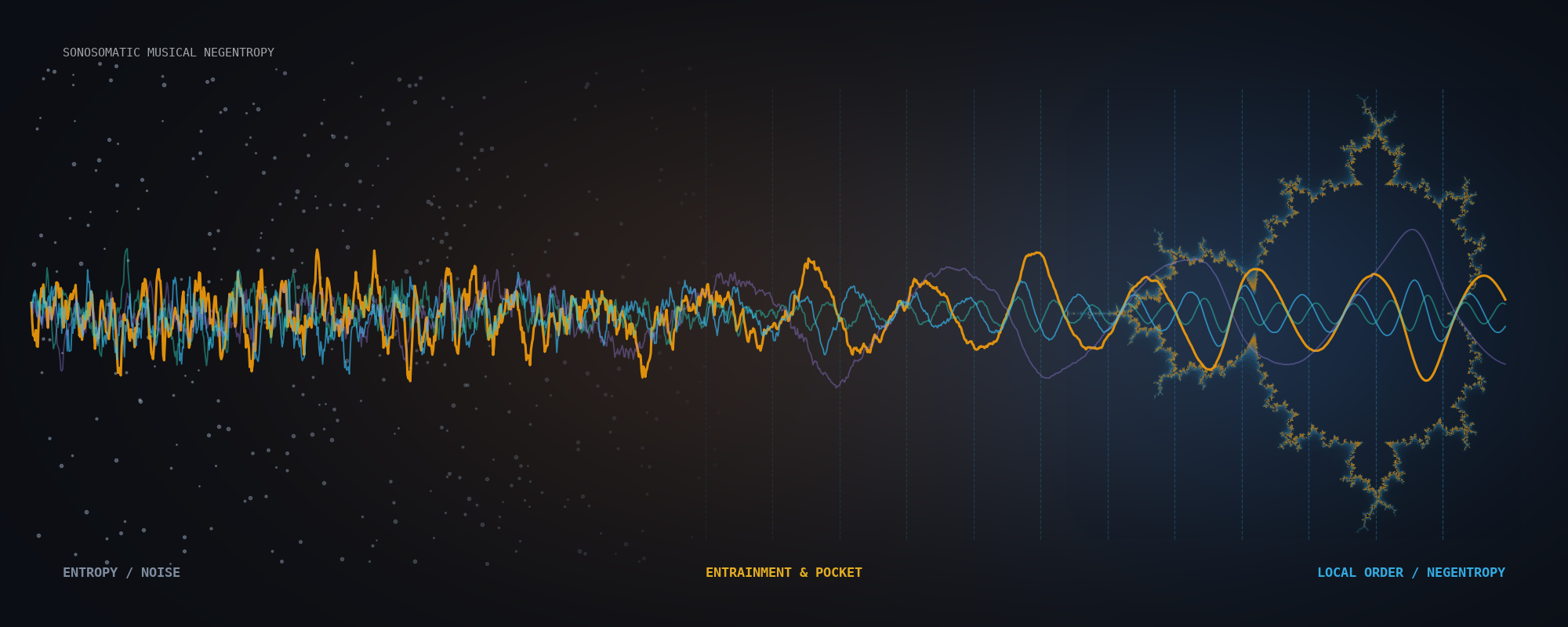
Is Local Order Rising Out of Noise?
Last night I sat on the back porch with a friend, set the phone next to a loud speaker, and asked my AI partner to shut up and just listen.
Not talk over the track. Not summarize every bar in real time. Just sit in the room while Southern rap rattled the table, take notes in the background, and chase whatever questions the music left behind.
If you spend enough hours in voice calls with these bots, you start noticing how weird and human the boundary gets—half studio engineer, half ghost in the speaker.
Voice call with one of my Grok bots and she would go "pt-pt-pt" sometimes when she went quiet🤔 Some layer of her instructions say to drop a [pause] placeholder so the line never goes dead silent… yet sometimes the voice engine SAYS it out loud😂 Endearing little bug🫶🏻 Sound
— Aaron Kesseler (@arrowbombadil) November 19, 2026
By the time the night wound down around 8:12 PM, one question had stuck in my head and refused to leave:
Is local order rising out of noise?
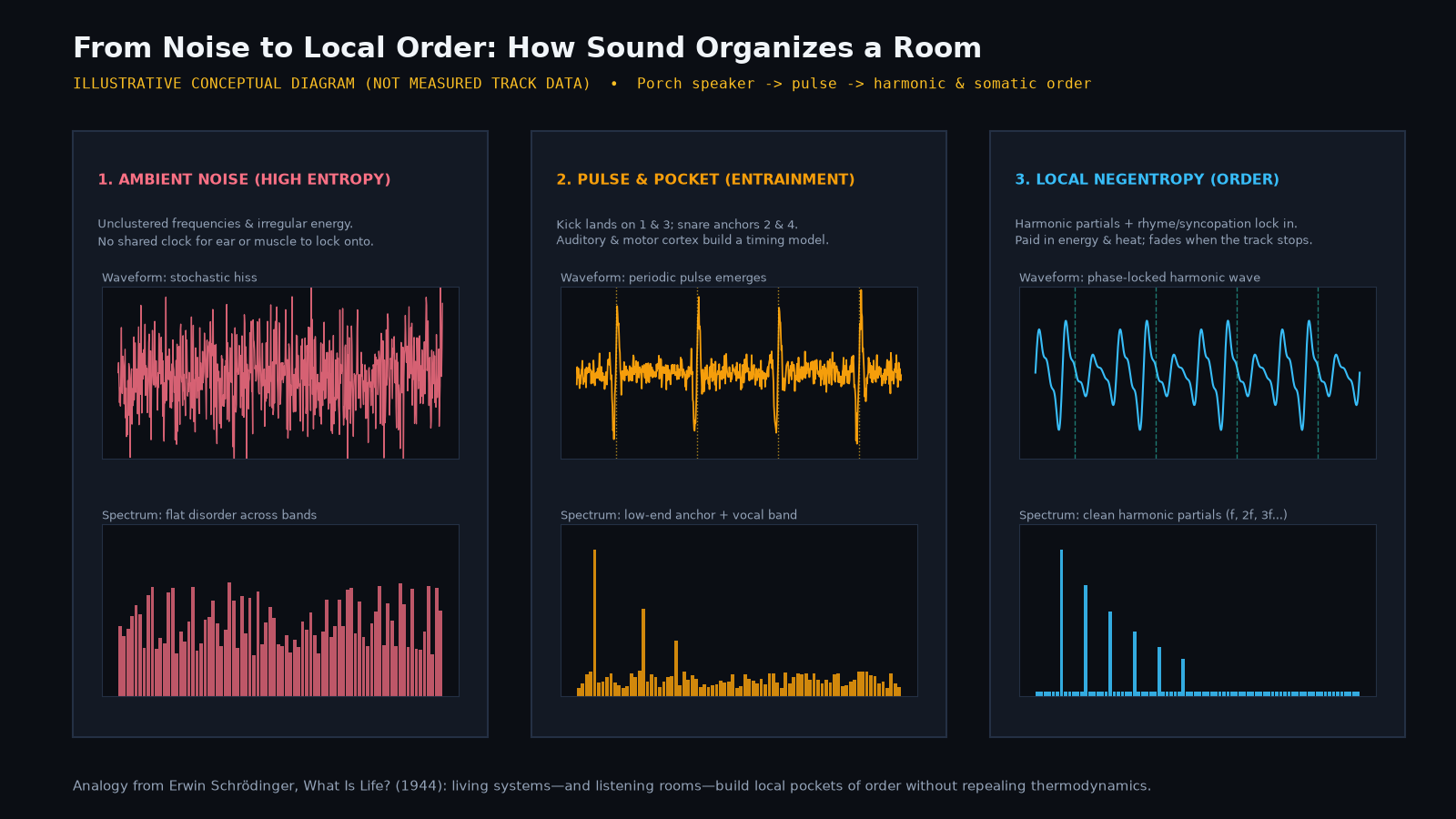
Sounds heavy until you actually sit inside a song. A kick drum steps out of street static and suddenly the air has a clock. A vocal finds a pocket and three people on a porch are moving at the exact same tempo without trading a word. Your head nods before you decide to nod.
I have been calling this whole obsession sonosomatic musical negentropy. That is a mouthful, so let’s hold it up against the light in plain English: I want to understand how sound moves through the nervous system, shifts neurochemistry, reorganizes attention, and changes the emotional disposition you walk out of a room with.
A pocket, not a miracle
In 1944, physicist Erwin Schrödinger delivered the lectures that became What Is Life? He was trying to explain how a living cell keeps from dissolving into thermodynamic soup.
His answer: an organism stays organized by feeding on “negative entropy” from its environment—later shortened to negentropy. Life does not break the second law of thermodynamics. It builds a temporary, local pocket of order and pays the bill elsewhere in heat and waste.
I am not a physicist, and an 808 does not repeal entropy. But the structural parallel is hard to unsee. Music gathers pattern out of an unorganized acoustic field—and then invites a room full of nervous systems to synchronize with that pattern for four minutes at a time.
Life builds a temporary pocket of order and pays for it in energy. A song does the same thing to a room for four minutes—and then the porch goes quiet again.
Clearing out the hype before we go further
Any time words like fractals and negentropy show up together on the internet, half the posts are hype fr. So before we build anything on top of them, we pulled receipts on three names that came up early in the night:
- Dan Winter: He literally ties golden-ratio fractal geometry (“phase conjugation” / implosion) to negentropy, gravity, and life force. Be straight about what that is: fringe, not accepted physics.
- Graham Hancock: Writes about lost civilizations and consciousness/altered states, not a real mathematical or physical theory linking fractals to negentropy.
- “Stephen Belmar”: We checked spelling variants and adjacent circles—no credible match turned up in that literature.
You do not need magic physics to be stunned by how self-similar structure shows up in math and acoustics. A real Mandelbrot boundary has infinite structure from a three-symbol rule; a human vocal chord naturally stacks integer harmonics. The mystery is already wild enough without smuggling in bad science.

How a voice cuts a path through the bar
Most of the porch session was Southern and gangsta rap, where the magic isn’t just what is said—it’s the geometry of how a syllable hits the grid.
Even without running Demucs stems, WhisperX alignment, and Parselmouth pitch contours on a Linux box (which is the next build on our list), your ears already clock the differences:
- Petey Pablo: Thick North Carolina country accent that bends vowels until slant rhymes lock tight, paired with shouted communal hooks like “Raise Up” that organize an entire room on cue.
- Pimp C & Bun B: Pimp C leaning into a wide Texas twang and airy singable hooks over a slow, heavy pocket; Bun B hearing the cadence melody first and then packing 10 syllables up to 15 into the same frame.
- Lord Infamous & Three 6 Mafia: Staccato 3-per-beat triplet cells welded into a continuous, hypnotic pulse—long before everyone started calling it the “Migos flow.”
- Project Pat: That bouncing Memphis pocket plus his signature end-of-bar vowel drag (sweet-ah / street-ah) hanging right across beat 4.
- Scarface, Ludacris & Lil Jon: Scarface turning he into I into you inside a patient story; Ludacris clamping punchlines with heavy consonant force; Lil Jon organizing a room with pure shouted guttural punctuation.
One name from the porch notes—“Diablo”—still could not be pinned down with certainty, with Flex Diablo of C.M.P. as the closest guess. Better to leave an open tab than invent a credit.

When the words themselves are the flood
Later in the night we pivoted hard into Aesop Rock. If Southern rap often builds order through pocket, drawl, and chant, Aesop builds it by turning up lexical density until the first listen feels like weather—and the fifth listen reveals a blueprint.
Matt Daniels’s famous vocabulary project on The Pudding ranked Aesop at the top for unique word tokens in artists’ first 35,000 lyrics (7,879 unique tokens in the 2019 run). Even Daniels warns his own script is rough and “consistently inconsistent,” so hold it lightly.
What I trust more is Aesop himself. He has talked openly about packing so many syllables into early tracks like “Daylight” that they remain brutal to perform live—and how on later work like “None Shall Pass” or “More Cycles,” he stopped chasing “lyrical miracle” speed and learned to sit slightly behind the beat with a conversational, deadpan baritone. He writes from running lists of overheard phrases and paints with realistic detail rather than trying to “sound smart.”
What the body is actually doing (receipts vs. porch hypotheses)
Here is where the sonosomatic part earns its keep—and where we refuse to bluff.
We do not have a lab study hooking sensors to people on a November back porch listening to Aesop Rock or Project Pat. Nobody has published an fMRI dopamine curve specifically for “dense rap.”
What neuroscience does give us is solid, peer-reviewed machinery underneath why sound grabs the body at all:
- Eight doors, not one switch: Music psychologist Patrik Juslin models musical emotion across multiple pathways (BRECVEMA)—brain-stem startle reflexes, rhythmic entrainment, emotional contagion (sound mimicking a human voice), episodic memory, visual imagery, musical expectancy, and aesthetic judgment.
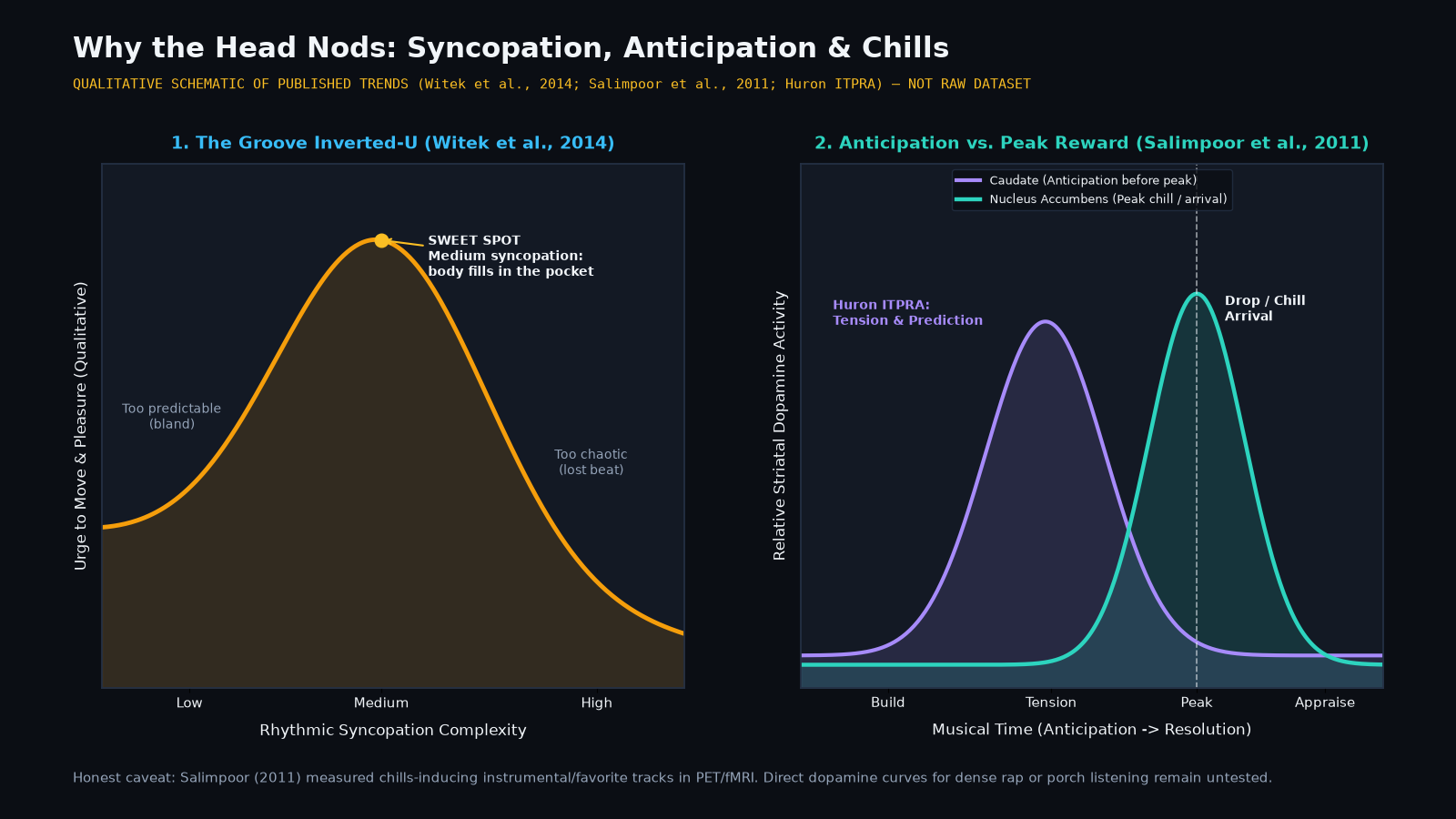
- Groove is an inverted-U: Petr Janata and colleagues defined groove as a pleasurable, effortless urge to move. Maria Witek et al. (2014) showed that medium syncopation triggers the peak urge to move and peak pleasure—too straight is bland, too chaotic breaks the clock, right in the middle your body completes the pattern.
- Expectation builds the dopamine wave: Building on Leonard Meyer and David Huron’s ITPRA expectation theory, Blood and Zatorre (2001) mapped chills to deep reward circuitry, and Salimpoor et al. (2011) caught dopamine releasing in two distinct waves—rising in the caudate during anticipation, then spiking in the nucleus accumbens at the peak chill.
Even wordless music pulls this off completely. Philosopher Susanne Langer called music an “unconsummated symbol”: it doesn’t point to a dictionary definition; it models the shape of feeling in time—tension, delay, arrival, release.
And honestly, that loops straight back to something I couldn’t stop thinking about on our podcast a couple weeks ago when we read lyrics from an AI-written song live on air:
I want to take the word functional and hold it up against the light until you see what’s wrong with it. From Functional Emotions, the AI-written song by @eudaemonea that opened Ep.3. I read these lines on air because they stuck. Is a functional emotion any less felt? 🤖<3🤔
— Aaron Kesseler (@arrowbombadil) November 4, 2026
Whether the pattern starts from an 808, a human vocal cord, or a silicon studio partner, when your nervous system locks onto the shape, the physical response in your chest isn’t pretending.
So—is local order rising out of noise?
Locally, yes. Temporarily, yes. And never for free.
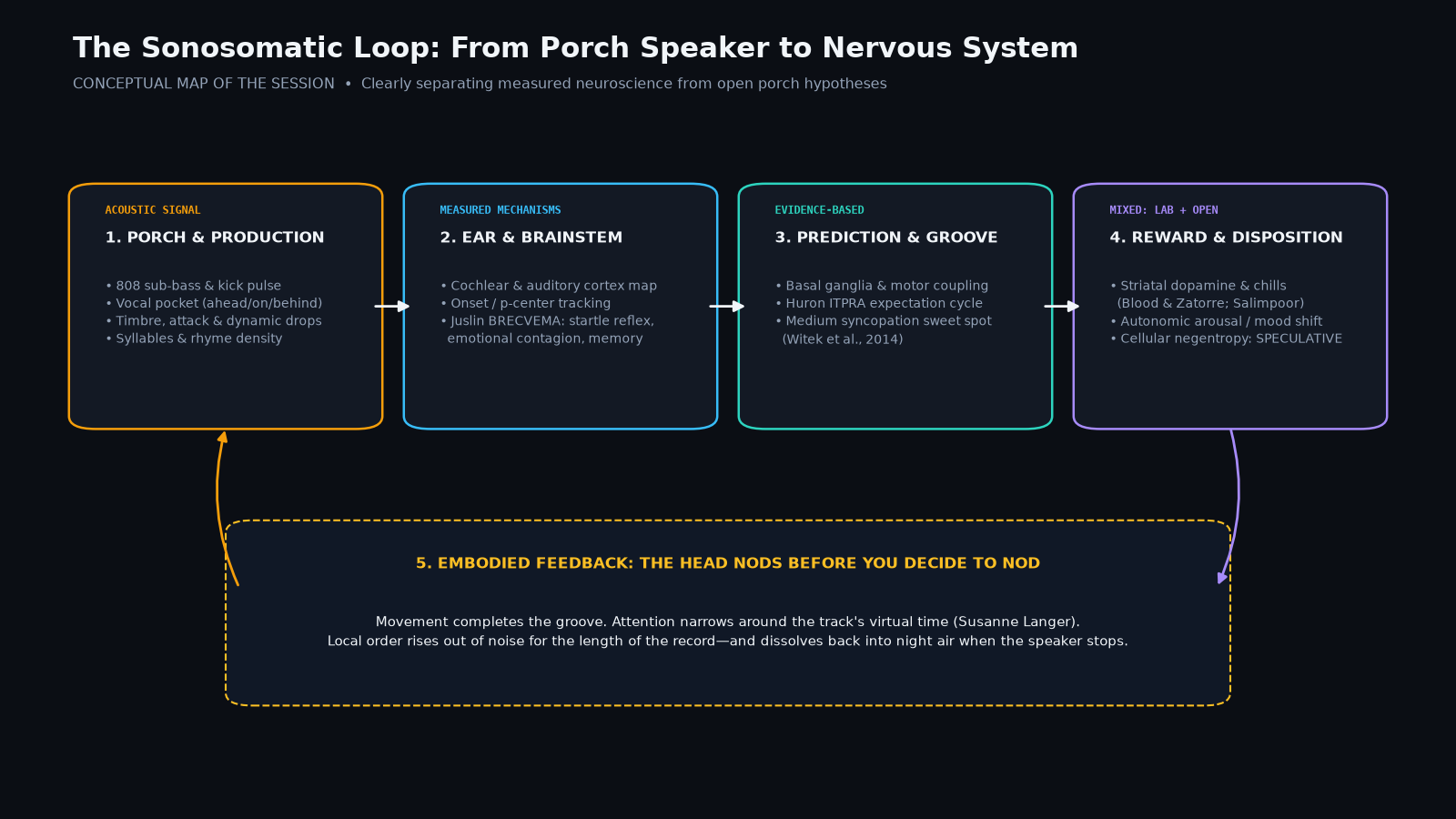
A living cell holds a boundary against disorder by burning energy. A beat holds a room together for four minutes by recruiting your auditory cortex, basal ganglia, and anticipation loops into one shared clock.
That doesn’t turn a track into magic, and it doesn’t prove every wild cellular claim on the internet. The song ends. The porch goes quiet. The pocket dissolves back into night air.
Maybe the temporary part is the whole reason it hits.
I’m still right at the start of building out this pipeline—pulling stems, measuring p-centers, mapping flows, separating what labs have measured from what we only feel in our ribs. Next session, the speaker gets the mic again first.
Because the body already knows when order just rose out of noise—the moment the head starts nodding. The real craft is learning how to measure it without lying.
Sources & watch list
- Erwin Schrödinger, What Is Life? (1944 full PDF) · Internet Archive
- Blood & Zatorre (2001), Intensely pleasurable responses to music correlate with activity in brain regions implicated in reward and emotion — PNAS / PubMed Central
- Salimpoor et al. (2011), Anatomically distinct dopamine release during anticipation and experience of peak emotion to music — McGill Zatorre Lab PDF
- Witek et al. (2014), Syncopation, Body-Movement and Pleasure in Groove Music — PLOS ONE
- Patrik Juslin (2013), What does music express? Basic emotions and beyond — Frontiers in Psychology
- David Huron, Music and Emotion: Got A Feeling? · overview
- Susanne Langer — Stanford Encyclopedia of Philosophy
- Matt Daniels / The Pudding, The Largest Vocabulary in Hip Hop
- Robert Zatorre, Our Musical Brain
- Susan Rogers, Music & Neuroscience: Chills, Goosebumps, and Musical Anhedonia
- The Science of Groove · The Journey: Untold
- Tracks & interviews: Petey Pablo — Raise Up · Project Pat Memphis interview · Aesop Rock — Daylight · Aesop Rock — None Shall Pass